
The study of African art history spans thousands of years, revealing a deep reservoir of innovation and creativity that has permanently shaped the global art scene.
The oldest known African art dates back 72,000 years, and across every corner of the African continent, diverse styles and distinct visual languages have continuously evolved through trade, migration, and cultural exchange, yet each maintains its own local identity.
Many contemporary African artists draw heavily from these various artistic traditions, merging historical techniques with modern themes. In the past, African art was rarely intended for pure visual beauty. Instead, objects were created to preserve history, express community values, and serve essential religious, political, or social purposes. Artworks in African traditions frequently embody symbolic meanings through specific forms, colors, and patterns, acting as spiritual vessels and community heritage.
To truly appreciate this richness, it helps to start at the beginning — with the foundational techniques and traditions that gave African art its distinctive voice.
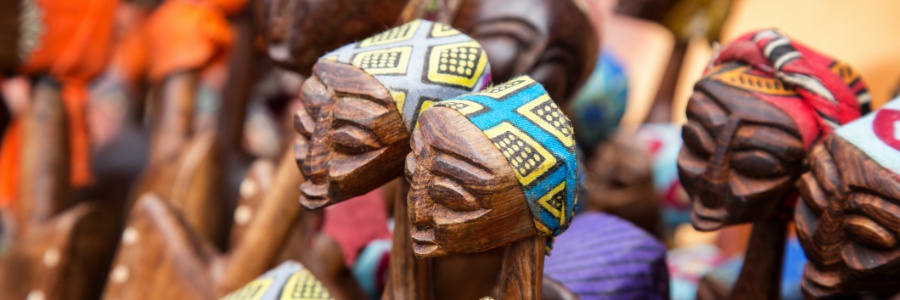
Wood carving is a widely practiced tradition across African societies, commonly used to depict ancestors and spiritual guardians. In many African societies, wood carving is a vital medium for honoring ancestors and spiritual guardians. Because ancestors are believed to actively influence the living, artists carve human figures and heads to serve as essential points of contact with the spiritual realm. Similarly, carved wooden masks play a crucial role in community ceremonies, such as rites of passage and funerals. During these rituals, the masks act as conduits for unseen spirits, shifting the dynamic of social spaces. And rather than existing as isolated objects, these traditional carvings are dynamically integrated with music, dance, and costumes, bringing art to life during both celebratory and solemn gatherings.
Visual abstraction has long been a core feature of traditional African art, predating Western abstract movements by centuries. At the heart of this tradition is the human body, which artists frequently abstract to emphasize internal qualities over literal realism. This abstraction is not merely aesthetic. Craftsmanship in African art is deeply tied to moral character and spiritual effectiveness.
To convey a leader’s status, artists often employ hieratic scale, a technique where a figure’s size reflects their social or spiritual importance. Underpinning all of this are bold geometric forms, which define the foundational aesthetic principles of these works. Dogon sculptures are a prime example, depicting figures with raised arms and geometric shapes to symbolize the connection between earth and sky.
Ceramic traditions in Africa serve practical and ceremonial purposes, with decorative patterns identifying regional customs. Terracotta figures represent some of the earliest sculptural records on the continent. For example, the Nok culture thrived in Nigeria from 1500 BC to 500 AD, creating stylized terracotta figures known for their elongated human heads and expressive features. Similarly, Yoruba art is celebrated for its detailed masks and naturalistic sculptures, showing an unparalleled level of sophistication in three-dimensional form.
Beyond clay, metalworking traditions in Africa symbolize political authority and showcase advanced technological achievement. Ife sculptures, dating from 1000 to 1800 CE, are famous for their lifelike style. This mastery shocked early European visitors who incorrectly assumed Africans could not produce such refined brass work. In the same way, the world-famous Benin Bronzes were created from the 13th century onward to decorate the royal palace of the Kingdom of Benin in Nigeria. Cast using the complex lost-wax technique to depict historical events, these bronzes fundamentally challenged Western perspectives on craftsmanship after they were plundered and dispersed into European museum collections, such as the British Museum and the Metropolitan Museum.
In the early twentieth century, Western perceptions of visual art underwent a big change, driven by encounters with African art. Previously dismissed as “primitive” by Westerners who overlooked its intellectual depth, African art soon became a source of profound inspiration. Artists like Picasso drew heavily from the stylized abstraction of African masks, using these forms to pioneer Cubism. By adopting this abstraction and emotional depth, Western art movements finally recognized that fine art could serve a purpose beyond simple decoration.
However, the true power of these artistic traditions lies in their deep narrative roots. For generations, textiles, beadwork, and community-driven arts have served as complex visual languages. For instance, Ghanaian Kente cloth uses specific colors and patterns to symbolize royal power and tell historical stories. Similarly, intricate beadwork across various African cultures uses vibrant colors to communicate social indicators, such as age, wealth, and marital status.
This tradition of visual storytelling also thrives in painting, as seen in Edward Saidi Tingatinga in Tanzania in 1968, this style features bold, flat colors and strong outlines, often depicting wildlife in busy, dense compositions. Today, the Tinga Tinga Arts Cooperative Society continues to preserve and promote this art, maintaining the lasting legacy of rich narrative traditions.
The twentieth century brought profound political shifts, prompting Nigerian art schools and other regional hubs to chart a new path. The Zaria Rebels formed in Nigeria in 1958 to redefine art education, mixing indigenous cultural references with modern themes to reject European art hegemony. This movement birthed African modernism, a style that kept local roots while participating in global art dialogues.
In the modern era, contemporary African art has exploded onto the global stage, earning widespread recognition from major museums, such as the Tate Modern, while driving intense competition among international auction houses and galleries. Far from representing a single trend or aesthetic, this movement spans a rich diversity of artistic languages and styles. Through these varied mediums, creators explore complex, deeply personal themes, using their work to drive social commentary and address issues of identity, migration, and political change.
Many contemporary African artists explore themes of urbanization and globalization, often incorporating traditional or recycled materials to ground their work in cultural heritage. A standout example is Ghanaian master El Anatsui, who transforms thousands of crushed aluminum bottle caps bound with copper wire into shimmering, textile-like installations. Since gaining international recognition in the late 1990s, his works achieve prices exceeding $3 million at auction today — a testament to the growing global demand for contemporary African mixed-media art.
This international appetite for African art is also reflected in the rise of major art biennials in cities such as Dakar and Johannesburg, positioning the continent as a hub for artistic innovation. From creating ancient rock art depicting animals and human figures to modern mixed-media sculptures, Africa continues to be a powerhouse of creative energy. Today’s artists are redefining what visual art can achieve, bringing centuries-old stories that were once ignored to the forefront. For collectors who want to invest with purpose, these works offer something rare: authenticity, emotional depth, and a richer understanding of human history.
Discover original, captivating artwork from the continent’s most promising talents by exploring the curated contemporary collections at Borderless Canvas today.