
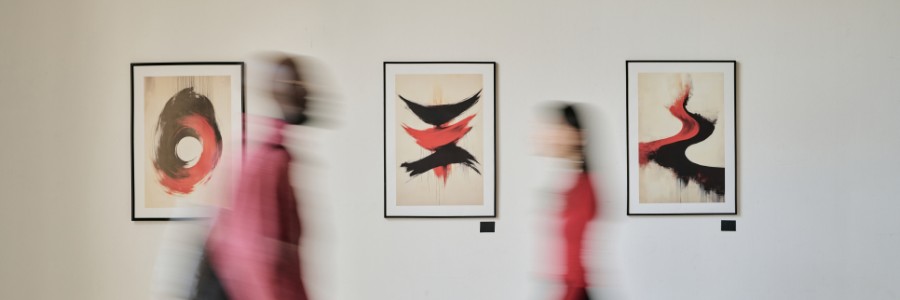
The world of contemporary Asian art has never been more visible or accessible. As global interest in the region’s creative movements grows, artists across Asia are drawing on centuries of history while responding to current cultural, political, environmental, and technological realities. From experimental installations in Japan and digital works in South Korea to figurative painting from India and emerging voices across Southeast Asia, the region is shaping conversations on the global stage.
Contemporary Asian art is not one movement, style, or market. It encompasses many artistic traditions, philosophies, and perspectives across diverse Asian countries. For collectors, understanding that range helps turn collecting from the purchase of beautiful objects into the creation of a meaningful collection.
This guide introduces the diverse art communities, ideas, and practical considerations that can help collectors approach contemporary Asian art with greater confidence.
Key takeaways
|
Contemporary Asian art encompasses work by artists from across the continent who engage with the ideas, experiences, and challenges of the modern world.
These artists may reinterpret historical narratives, draw on inherited cultural traditions, or push the boundaries of artistic expression entirely. Traditional oil painting sits comfortably alongside sculpture, photography, ceramics, textile art, installation, performance, mixed media, animation, and new media. The range of voices and approaches is as wide as the continent itself.
Geographically, the field spans an enormous territory. East Asia has produced internationally celebrated figures such as Yayoi Kusama, Takashi Murakami, and Yoshitomo Nara. Yet equally vital contributions continue to emerge from India, Pakistan, Bangladesh, Singapore, Indonesia, Vietnam, the Philippines, Thailand, Malaysia, and countless other corners of Asia — artists whose work deserves far greater attention than it often receives.
What binds these artists together is not a common style or tradition, but a living, breathing conversation. Contemporary Asian art is a dynamic exchange of ideas that flows across borders, generations, and disciplines: a dialogue that continues to grow and evolve with every voice that joins it.
At the heart of much of this work lies a compelling tension between past and present. Rather than simply reproducing traditional imagery, many artists ask deeper questions: how do inherited customs, beliefs, and visual languages continue to shape modern life? How does history live in the body, the home, the landscape? It is this reflection on memory and identity that gives contemporary Asian art so much of its resonance and depth.
Far from a single movement or aesthetic, contemporary Asian art is a vast and richly layered field that resists easy definition and rewards closer exploration.
In East Asia, artists from Japan, China, Taiwan, and South Korea have contributed to abstraction, conceptual practice, performance art, digital experimentation, and animation. Prominent Japanese figures have helped introduce broad international audiences to the field through museum exhibitions, public installations, and global collaborations.
Meanwhile, China’s contemporary art scene reflects decades of rapid social and economic change. Movements such as cynical realism and contemporary ink art show how artists respond to modern life while reworking historical traditions. The latter, for example, applies classical Chinese ink techniques to present-day themes.
Across Southeast Asia, artists explore colonial histories, indigenous knowledge, environmental change, migration, spirituality, and community. As recognition grows, the region has become one of the most dynamic and accessible areas for new collectors.
South Asian artists examine religion, politics, urban development, gender, identity, and globalization while drawing on some of the world’s oldest artistic traditions.
These countries do not exist in isolation. Artists study abroad, join international residencies, collaborate across disciplines, and exhibit together in museums and biennales. The result is a creative ecosystem shaped by both local identity and global exchange.
For collectors, that diversity creates an opportunity to build a collection that reflects personal taste while engaging with Asia’s cultural breadth.
Collectors, museums, galleries, and cultural institutions are increasingly waking up to the remarkable depth and innovation of artists from across Asia.
International exhibitions and fairs have played an important role in this growth. Art Stage Singapore has introduced wider audiences to artists from across the region. At the same time, biennales and museum exhibitions continue to create dialogue between Asian artists and their counterparts in Europe, North America, and elsewhere.
Museum retrospectives can also change how an artist is understood. In 2016, No Limits: Zao Wou-Ki became the artist’s first major retrospective in the United States, showing American audiences how he brought Chinese artistic traditions into conversation with postwar abstraction.
Furthermore, institutions such as the Asian Art Museum in San Francisco also help audiences connect the past and present by displaying contemporary works alongside historical collections. Their exhibitions present artistic traditions as living practices rather than fixed moments in time.
Curators, researchers, and conservators play a pivotal role in shaping these experiences, providing context and determining how works are presented. For collectors, exhibition catalogues, gallery talks, and wall text can therefore prove to be invaluable sources of information.
Beginning a collection does not require expert knowledge or an unlimited budget. Many strong collections start with one work that creates a lasting emotional or intellectual connection.
Start by exploring different artists, regions, and media. Visit galleries and museums, attend exhibitions, and read artist interviews, essays, and catalogues. Compare painting, sculpture, photography, mixed media, editions, and digital works.
Before buying, ask:
Collector Yuichi Kawasaki offers a useful example. A single encounter with a Yayoi Kusama artwork eventually led him to build a collection of more than five hundred works. His experience shows how a collection can develop gradually through curiosity rather than volume.
When collecting contemporary Asian art, it’s important to understand that the value of a piece is not always tied to its technical complexity. A minimalist installation or a short video piece can carry just as much intellectual and emotional weight as a meticulously detailed oil painting. In fact, some of the most thought-provoking works in this space are deceptively simple on the surface.
This is why context is everything. The cultural backdrop, the artist’s personal history, the socio-political climate in which a work was created — all of these layers can unlock meanings that aren’t immediately visible to the untrained eye. Taking the time to research and understand these elements can completely transform your appreciation of a piece and, ultimately, the strength of your collection.
Price and importance don’t always move in the same direction.
Market value is shaped by a range of factors: an artist’s reputation, provenance, exhibition history, rarity, condition, medium, gallery representation, and demand. These can shift considerably as artists develop their careers and gain institutional recognition.
Historical significance, however, often follows its own path. Some artists receive widespread recognition only decades after producing their most influential work. Others may have shaped a major movement while leaving behind a limited auction record. The two measures — market and meaning — don’t always align.
The distinction is especially worth considering in emerging markets. Across Southeast Asia, for example, many accomplished artists remain comparatively affordable despite growing international interest. For collectors, this can represent an opportunity to support important practices at a formative stage.
Editions and works on paper offer another route in. They often allow collectors to acquire work by established artists at a lower price point than unique paintings or sculptures, without sacrificing quality or significance.
Ultimately, market performance is best understood as one part of a broader assessment. Cultural importance, artistic innovation, personal resonance, and an artwork’s contribution to an artist’s overall career may prove far more enduring than short-term price movements.
Collecting doesn’t end at the point of purchase. In fact, preserving an artwork is part of preserving its history.
Start with documentation. Keep certificates of authenticity, invoices, exhibition records, provenance documents, and any relevant correspondence. Good records protect both the integrity and long-term value of a collection.
Physical care matters just as much. Keep works away from direct sunlight, excess humidity, and extreme temperature changes. Works on paper should be mounted using conservation-quality, acid-free materials, while sculptures, installations, and digital works may require specialist handling.
Finally, think about presentation. Whether a work is displayed at home or in an office, it should have enough space to breathe and be properly appreciated. Lighting should enhance the work without causing long-term damage.
Together, these practices help ensure that the artworks you collect retain their meaning and value for generations to come.
At Borderless Canvas, we believe every artwork is more than something to own. It carries an artist’s ideas, experiences, and perspective while contributing to a broader cultural conversation.
One of our missions is to make contemporary Asian art more accessible by helping collectors understand the stories, histories, and cultural narratives behind the works they acquire. By presenting artists from across Asia, we aim to reflect the diversity of a creative landscape that cannot be defined by a single country, movement, or style.
This understanding is what gives collecting greater purpose. Collecting with knowledge and intention not only brings meaningful art into your life but also supports artists, encourages cultural exchange, and contributes to a deeper appreciation of Asia’s artistic achievements. The strongest collections are not built around trends alone. They are shaped by knowledge, curiosity, and a genuine connection to the work.
Whether you are purchasing your first piece or expanding an established collection, take the time to explore widely, ask questions, and understand the artist’s perspective.
Ready to begin your journey into contemporary Asian art? Browse the Borderless Canvas collection and discover works that speak to you.